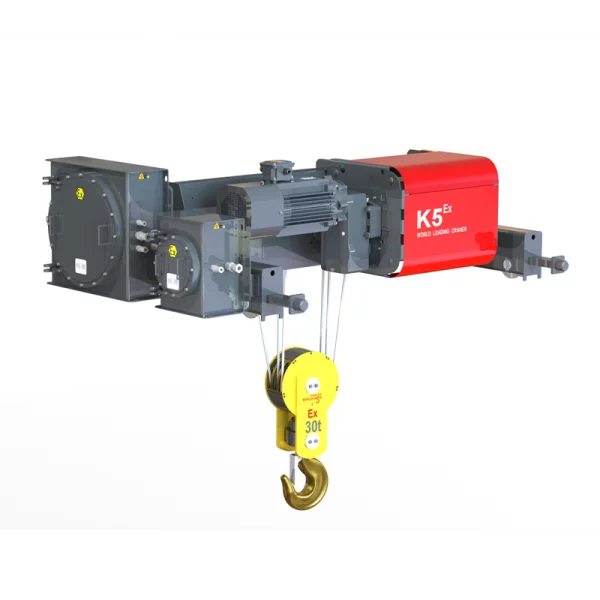
Selecting the right lifting equipment requires more than comparing lifting capacity or purchase cost. Facilities must consider operating frequency, load characteristics, available space, positioning accuracy, maintenance requirements, and the overall material flow. The wire rope hoist is widely used where dependable vertical lifting and controlled load movement are required, while specialized systems such as a stacker crane are designed for automated storage and retrieval.
Understanding how these systems differ can help operations teams select equipment that fits both current requirements and future workflow needs.
What Is a Wire Rope Hoist?
A wire rope hoist uses a motor-driven drum or similar mechanism to wind and unwind steel wire rope for lifting and lowering loads. Compared with simpler lifting mechanisms, it can provide the capacity, lifting height, and duty performance required for demanding industrial environments.
Wire rope hoists are commonly integrated with overhead cranes, gantry cranes, monorail systems, and other lifting structures. Their configuration can vary according to lifting capacity, lifting speed, travel requirements, working environment, and available installation space.
When selecting a wire rope hoist, users should evaluate more than the rated load. The actual application may require consideration of lifting height, duty classification, operating cycles, load dimensions, ambient conditions, and the required level of positioning control.
When Is a Wire Rope Hoist a Practical Choice?
A wire rope hoist is particularly suitable when material handling involves frequent lifting and lowering across a defined working area. Manufacturing facilities, workshops, warehouses, maintenance areas, and production lines may use overhead lifting equipment to move components, machinery, raw materials, and finished products.
One important advantage is its adaptability. A wire rope hoist can be combined with different crane structures depending on the facility layout. This allows the lifting system to serve production stations, storage areas, loading zones, or maintenance locations without requiring a completely automated storage infrastructure.
For operations where loads vary significantly in size and weight, selecting the correct hoist configuration is essential. The equipment should provide sufficient capacity without being unnecessarily oversized, while the control system should allow operators to position loads accurately and safely.
Wire Rope Hoist and Automated Storage Systems
Not every material handling application requires the same type of equipment. A stacker crane AS/RS is designed for automated storage and retrieval, typically operating within dedicated storage aisles. In contrast, an overhead crane equipped with a wire rope hoist is generally intended for flexible lifting and horizontal movement within a defined workspace.
An automated stacker crane can retrieve and store loads according to warehouse management instructions, reducing the need for manual intervention in repetitive storage operations. A storage retrieval crane can therefore be useful where high storage density, systematic inventory movement, and automated material flow are important priorities.
The distinction is primarily based on the workflow. If the main requirement is lifting and transferring loads between work areas, a wire rope hoist system may be more appropriate. If the requirement involves automatically storing and retrieving loads from structured rack locations, an automated storage system may offer a better fit.
Key Factors When Selecting a Wire Rope Hoist
Load capacity is one of the first specifications to establish, but it should not be considered independently. The maximum working load, typical load range, lifting height, lifting speed, and operating frequency all affect the appropriate equipment configuration.
The working environment also matters. Dust, humidity, temperature variations, corrosive substances, and outdoor exposure can influence component selection and maintenance requirements. Electrical protection and structural considerations should also correspond with the installation environment.
Control requirements deserve attention as well. Manual pendant controls may be suitable for straightforward operations, while radio controls or more advanced control arrangements can provide greater flexibility where operators need improved visibility around the load.
Maintenance access is another practical consideration. Hoisting equipment operates under mechanical and electrical loads, so inspection of wire rope, drums, brakes, hooks, limit devices, and other critical components should be incorporated into the operating plan.
How WORLDHOISTS Supports Hoisting and Lifting Applications
WORLDHOISTS provides hoisting and lifting equipment for applications that require dependable load movement and appropriate system configuration. Its product range allows users to evaluate lifting solutions according to application requirements rather than relying on a single equipment type.
For projects involving a wire rope hoist, the selection process should begin with the operating conditions and material flow requirements. Capacity, lifting height, duty cycle, installation configuration, control method, and maintenance considerations can then be used to determine the appropriate system.
Where a facility also includes automated storage, the relationship between conventional lifting equipment and systems such as a stacker crane AS/RS should be considered during the planning stage. This can help avoid selecting equipment that does not align with the intended material flow.
Building a Suitable Material Handling System
Choosing lifting equipment is ultimately about matching equipment capabilities with the movement requirements of a facility. A wire rope hoist offers a practical solution for controlled lifting and load transfer, while stacker crane systems address a different requirement centered on automated storage and retrieval.
Before making a selection, users should define the loads being handled, movement frequency, lifting height, workspace limitations, environmental conditions, control requirements, and maintenance expectations. A clear understanding of these factors makes it easier to select equipment that supports safe operation and consistent material flow.
For facilities that need reliable lifting across production, storage, or maintenance areas, a properly specified wire rope hoist can provide the foundation for an effective material handling system.
