Choosing a molding process for a silicone component is rarely a matter of selecting the most advanced machine available. The better question is whether the manufacturing method fits the part, quantity, material, tooling investment, and production objective.
A process designed for highly automated, high-throughput manufacturing may introduce unnecessary complexity when a project needs a smaller batch of relatively straightforward elastomer components.
That is where compression molding becomes relevant. HordRT describes the process as using silicone material loaded into a mold, followed by controlled heat and pressure to form and cure the component. Its published capabilities cover small to large parts and single- to multi-cavity tooling, making the process adaptable to different production requirements.
Start With the Part, Not the Molding Machine
The starting point should be the component’s function. A silicone seal, protective boot, diaphragm, keypad, or flexible cover may require elasticity, sealing performance, temperature resistance, or repeated deformation rather than the extremely fast automated cycles associated with some high-volume molding systems.
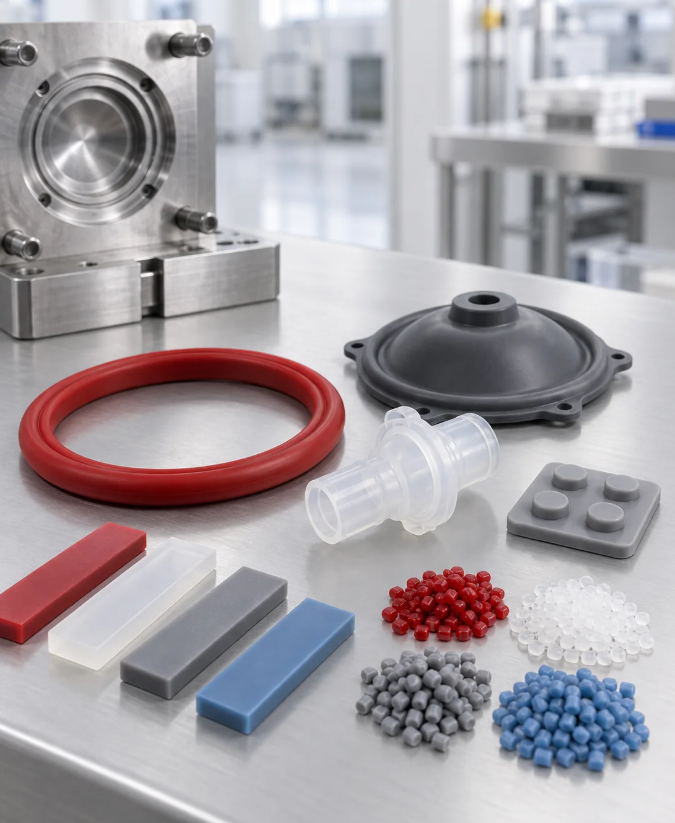
HordRT’s current silicone molding guidance identifies seals, gaskets, diaphragms, membranes, keypads, buttons, boots, and protective covers as typical compression-molded components. The company also recommends reviewing geometry, operating conditions, material requirements, and quantity before determining the manufacturing approach.
That changes the process-selection question. Instead of asking whether compression molding is technologically sophisticated enough, engineers can ask whether its capabilities cover the actual functional requirements of the component.
A relatively simple silicone part may gain little from a more complicated manufacturing architecture if the additional equipment does not create a meaningful improvement in the finished product.
When Simplicity Becomes a Manufacturing Advantage
The basic compression cycle has fewer specialized elements than several alternative silicone molding approaches.
HordRT describes a conventional cycle in which silicone material is placed into the mold, the mold closes, heat and pressure are applied, the material cures, and the finished part is removed. The company’s earlier process description contrasts this structure with LSR injection molding and silicone transfer molding, which use additional material-delivery systems.
That simplicity can matter during product development.
A project may require a relatively small quantity of parts for functional testing, customer evaluation, assembly validation, or an initial production run. In such cases, a manufacturing process with fewer specialized systems can provide a practical route to molded components without requiring the project to immediately adopt a highly automated production architecture.
Simplicity should not be confused with a lack of engineering requirements. Mold accuracy, material preparation, curing conditions, flash control, and inspection still determine the quality of the finished part. The advantage is that the overall manufacturing system can remain proportionate to the project’s needs.
Production Quantity Changes the Tooling Equation
The number of parts required can completely change how a molding process should be evaluated. Tooling designed for a large production program may justify automation, complex material handling, and higher initial investment. A development program with hundreds or a few thousand components faces a different economic calculation.
HordRT states that its silicone compression molding service supports prototypes, bridge quantities, and repeat production, with no minimum order quantity. Its published process information also notes that multiple cavities can be configured on a mold plate to increase productivity when production demand requires it.
This creates room for tooling to evolve with demand. A single-cavity configuration may make sense while a product is being validated, whereas a multi-cavity arrangement can become more attractive once recurring demand is established.
The important point is that cavity count should follow the production requirement rather than being treated as a fixed characteristic of the process. Tooling investment and output capacity can be adjusted around the project’s actual stage.
Complexity Has a Different Meaning in Silicone Molding
Part complexity does not automatically rule out compression molding. A silicone component can contain undercuts, flexible sections, sealing lips, grooves, or other features that would be difficult to interpret using rules developed for rigid thermoplastic parts. Silicone’s flexibility can make certain geometries easier to release than their rigid counterparts.
HordRT’s current design guidance specifically notes that silicone’s flexibility can allow some undercuts while still requiring careful consideration of part release. It also recommends reviewing parting-line placement, flash control, wall thickness, transitions, and sealing features before tooling begins.
Consequently, “complex” should be separated into several different questions. Does the geometry require difficult tooling? Does the part need extremely tight dimensional control? Is the critical feature a sealing surface? Will the component deform during removal? Does the part require extensive automation?
A component can have intricate geometry while remaining suitable for compression molding if the mold architecture and demolding strategy are practical. Conversely, a visually simple component can become difficult if its critical dimensions, production rate, or automation requirements demand tighter process control.
The Transition From Prototype Parts to Repeat Production
Another reason to consider compression molding is that the same basic process can support more than an isolated prototype. HordRT’s current silicone service describes a workflow extending from part review and material selection through custom compression tooling, molding, inspection, and repeat production. The company specifically positions the process for initial samples, bridge quantities, and recurring manufacturing. That continuity can be valuable when a product is not yet ready for a large-scale manufacturing commitment.
An engineering team can begin with a relatively limited quantity, evaluate physical parts, refine the design if necessary, and then continue with additional production using the same general manufacturing route. If demand increases substantially, the tooling strategy can be reconsidered rather than forcing the original setup to serve every future production requirement.
This staged approach also reduces the pressure to predict the entire product lifecycle before the first molded parts exist.
Making Compression Molding Part of the Process Decision
The right question is therefore not whether compression molding is cheaper, simpler, or better in the abstract. Its suitability depends on the relationship between the part and the manufacturing objective.
A practical evaluation can begin with five variables: material, geometry, required quantity, dimensional and functional requirements, and expected production evolution. HordRT’s current project-review workflow follows a similar logic by examining geometry, sealing requirements, operating conditions, quantity, material, tooling, and inspection requirements before production.
Production volume may determine whether single- or multi-cavity tooling is appropriate. Part geometry can influence parting-line and demolding decisions. Material requirements can determine the necessary curing approach. Functional requirements establish which dimensions and surfaces deserve tighter control.
Alternative processes should then be considered against the same criteria rather than judged by technology level alone. LSR injection molding may be appropriate for projects requiring a different material-delivery system and production strategy, while transfer molding can introduce another tooling and material-flow configuration. Compression molding remains particularly relevant when a controlled charge of silicone, heated tooling, and direct compression provide an adequate route to the required component.
For engineering teams, that makes process selection less about finding the most sophisticated manufacturing method and more about eliminating unnecessary mismatch. The right molding technology is the one whose tooling architecture, production economics, process control, and output characteristics align with what the part actually needs.
In that context, compression molding is not simply an alternative silicone process. It is a manufacturing option that can occupy a useful position between prototype development and repeat production, particularly when the required component, volume, and tooling strategy justify a comparatively direct molding approach.
HordRT‘s current service structure reflects this broader role by connecting custom tooling, silicone molding, inspection, and production support within the same workflow.
