Utility-scale battery energy storage systems increasingly rely on modular power conversion architectures to balance capacity, efficiency, maintainability, and grid-support requirements. Central and string architectures approach this challenge differently, particularly in how battery clusters connect to PCS units and how power is aggregated before reaching the medium-voltage grid. For developers, EPC contractors, and system integrators, understanding these differences is essential when selecting a utility-scale PCS and designing the overall BESS topology.
Central and String Architectures Explained
A central architecture generally aggregates DC power from multiple battery units into larger PCS blocks. Several battery strings or racks may feed a centralized converter, with the AC output subsequently connected to a transformer and medium-voltage collection system.
A string architecture distributes PCS units across individual battery clusters or smaller groups. Each PCS handles a more localized portion of the battery capacity before multiple AC outputs are collected. This modular structure can change how engineers approach fault isolation, expansion, controls, and equipment placement.
Neither architecture exists independently from the rest of the BESS. Battery voltage, transformer configuration, site layout, grid requirements, and operating strategy all influence the appropriate topology.
Why 1500V PCS Architecture Is Increasingly Relevant
Higher battery-side voltage can reduce current for a given power level, which can influence conductor requirements and electrical losses. This is one reason 1500 Vdc architectures have become important in utility-scale storage.
Enjoypowers’ 1500 Vdc Utility-Scale PCS series illustrates this approach. Its published specifications list DC operating ranges of 600–1500 Vdc for the 400 Vac configuration, 840–1500 Vdc for 480 Vac, 1000–1500 Vdc for 690 Vac, and 1150–1500 Vdc for 800 Vac. The full-power DC range is specified as 920–1450 Vdc for the platform.
Importantly, 1500V PCS describes the battery-side architecture rather than requiring a 1500 V AC grid connection. The same platform supports 400 V, 480 V, 690 V, and 800 V AC configurations, allowing system integrators to match the PCS with different transformer and grid-connection arrangements.
Where a 250 kW Inverter Fits
A 250 kW inverter can serve as a modular building block within a distributed utility-scale design. Enjoypowers lists a 250 kW rated AC output for its 800 Vac configuration, alongside 125 kW at 400 Vac, 150 kW at 480 Vac, and 215 kW at 690 Vac.
This illustrates an important procurement point: rated power should always be considered together with AC voltage. A 250 kW rating is not a universal output for every voltage configuration of the platform.
For system integrators, modular PCS ratings can make it easier to configure larger systems from repeatable power-conversion blocks. However, the number of modules required, transformer arrangement, protection scheme, and site-level controls still need to be engineered around the project’s specific requirements.
Central Architecture: Aggregation and System-Level Design
Central PCS architectures can simplify the high-level power-conversion arrangement by concentrating conversion equipment into fewer larger blocks. This can be attractive where battery containers, DC collection, and transformer stations are already organized around centralized electrical infrastructure.
The trade-off is that a larger centralized conversion block can represent a more concentrated equipment dependency. Engineers therefore need to examine redundancy, maintenance access, spare-parts strategy, and the consequences of a PCS fault.
The physical design also matters. Centralized equipment may require appropriate electrical rooms, outdoor enclosures, or dedicated skid arrangements. Cable lengths between battery equipment and the PCS should also be evaluated because DC-side routing can influence installation complexity and losses.
String Architecture: Distributed Conversion
String architectures move conversion closer to individual battery clusters. This can create a more modular electrical structure and allow each PCS to operate with a smaller portion of the total battery capacity.
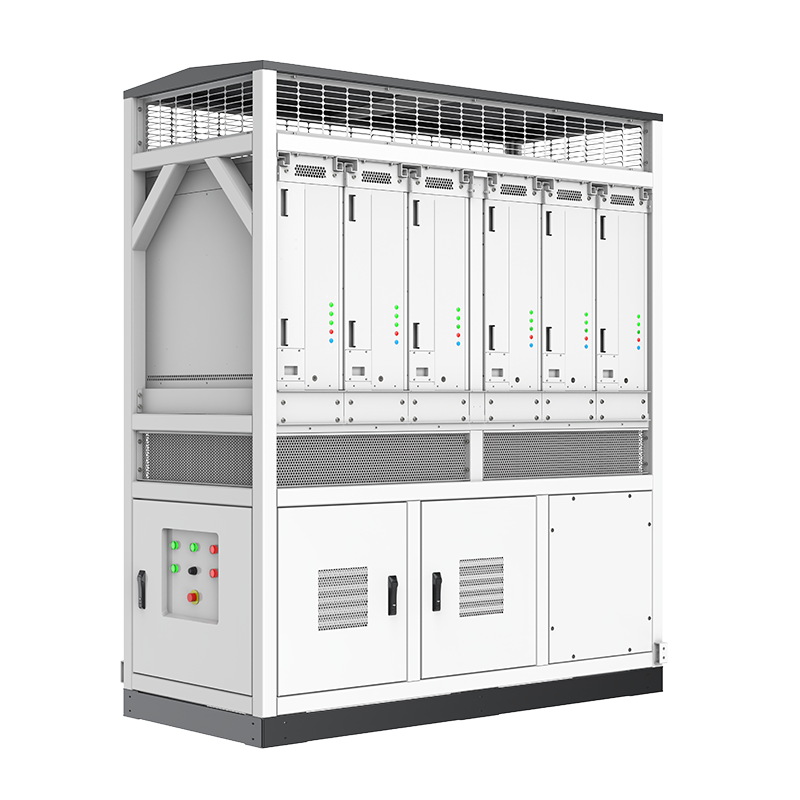
Enjoypowers describes its 1500 Vdc platform as a modular system that can be combined into outdoor cabinets and larger skid-mounted configurations. Its published system architecture includes outdoor cabinets containing four, six, or eight PCS modules, as well as 6–16 PCS modules combined with a transformer skid.
A distributed arrangement can also support more granular monitoring of battery clusters. If each conversion block corresponds to a defined battery group, engineers can more readily associate electrical behavior with specific parts of the storage system.
However, more PCS units mean more equipment interfaces, protection points, control coordination requirements, and maintenance considerations. The balance between modularity and system complexity therefore deserves careful evaluation.
Control and Grid-Forming Capability
Architecture selection should not focus only on hardware topology. Modern utility-scale BESS projects may require grid-forming functions, particularly where the storage plant must contribute to voltage and frequency stability.
Enjoypowers‘ 1500 Vdc PCS supports selectable grid-forming control using Virtual Synchronous Generator (VSG) or Virtual Force (VF) modes, as well as grid-following PQ control. Its published product information describes virtual inertia, primary frequency response, and virtual damping within the VSG approach.
The platform also states that up to 12 units can operate in parallel under VSG grid-forming control without communication wiring, with the manufacturer recommending EMS coordination for installations exceeding 12 units.
For EPC and integration teams, this means the PCS control architecture should be evaluated alongside the physical central or distributed topology.
Environmental Conditions and Battery Compatibility
Utility-scale storage equipment often operates outdoors, where temperature, humidity, dust, and corrosion can affect long-term performance. These conditions should therefore be included in the architecture assessment rather than treated as secondary specifications.
Enjoypowers specifies IP66 protection and smart forced-air cooling for its 1500 Vdc PCS. The company also states that the platform uses C5 corrosion protection and can maintain full rated output at 50°C ambient temperature without derating.
Battery chemistry is another consideration. Enjoypowers states that its platform includes sodium-ion charge profiles and has undergone BMS integration testing with multiple sodium-ion cell vendors.
These capabilities can be relevant as utility-scale projects diversify beyond conventional battery configurations.
Selecting an Architecture Around the Whole BESS
Central and string architectures should ultimately be evaluated as complete electrical systems rather than as isolated inverter choices. Battery configuration, DC voltage, PCS rating, transformer topology, grid code, protection, controls, environmental conditions, and maintenance strategy all influence the final design.
The 1500 Vdc platform from Enjoypowers demonstrates how modular PCS hardware can support several AC voltage configurations and system arrangements, from individual modules to multi-module cabinets and transformer-skid systems.
For business project teams, the key is to match the architecture to the site’s electrical and operational requirements. A well-engineered utility-scale BESS does not depend on the nominal size of a single 250 kw inverter or the label of a central or string topology. Instead, performance comes from coordinating the battery, PCS, transformer, controls, protection, and grid interface as one integrated system.
