Professional additive manufacturing depends on more than the performance of the printer itself. Supporting equipment can influence production stability, material handling, post-processing, and overall workflow efficiency. For dental laboratories and other professional users, selecting and managing 3D printing tools and accessories as part of an integrated production system can help reduce interruptions and improve consistency. The right supporting equipment should therefore be evaluated according to both technical requirements and daily production needs.
- Match Accessories for 3D Printing to the Printer
The first step toward better efficiency is compatibility. Different 3D printing technologies have different requirements for operating environments, materials, gas supplies, cleaning, and post-processing. Using supporting equipment that is appropriately matched to the printer can prevent unnecessary adjustments and help maintain stable production conditions.
For metal additive manufacturing, protective gas is particularly important. Per official specifications, Riton’s MLAB metal 3D printer, for example, uses nitrogen or argon as protective gas and is designed for CoCr and titanium alloys. This means gas-generation equipment should be selected according to the printer’s actual operating requirements rather than treated as a generic accessory.
- Prioritize Stable Gas Quality
Gas management is one of the most important considerations when selecting 3D printing tools and accessories for metal production. An appropriate gas supply can help laboratories maintain the controlled conditions required by their printing process.
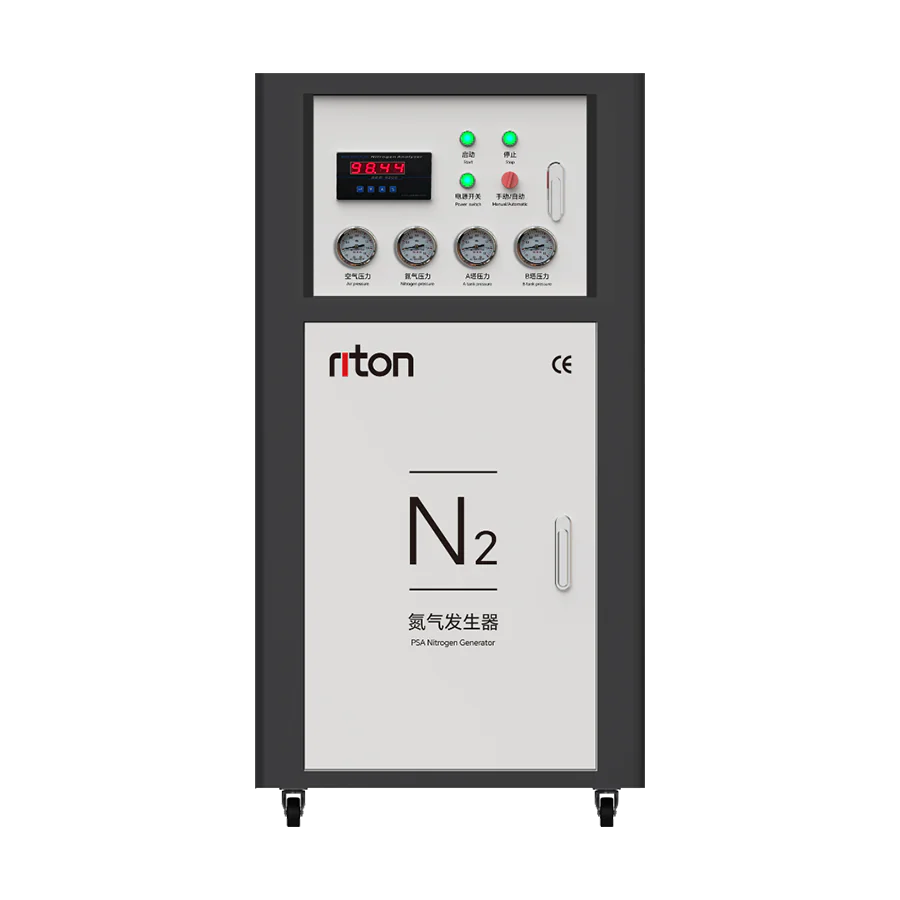
Per official specifications, Riton’s RXT-3000L nitrogen generator uses pressure swing adsorption (PSA) technology to produce nitrogen for metal additive manufacturing or metal 3D printing. Its nitrogen purity is adjustable from 99% to 99.999%, while production capacity ranges from 8 to 2 m³/h depending on the selected purity level.
This adjustable capability allows users to align gas production with operational requirements rather than continuously producing nitrogen at a single specification. The system also incorporates nitrogen purity monitoring, helping operators keep closer track of gas quality during production.
- Automate Repetitive Supporting Tasks
Efficiency gains do not always come from increasing printer speed. Supporting operations can also become production bottlenecks when they depend heavily on manual intervention.
Businesses should therefore evaluate accessories for 3D printing based on how effectively they simplify repetitive activities. Automated or intelligently controlled equipment can reduce unnecessary operator involvement and make production procedures easier to standardize.
The RXT-3000L, for example, features intelligent start-stop control for nitrogen production. Rather than requiring operators to manually manage every stage of gas generation, the control system is designed to make the auxiliary process more convenient. For professional laboratories, such automation can help operators focus more attention on production and quality management.
- Consider Space, Utilities, and Workflow Together
A technically capable accessory may still be inefficient if it creates installation or workflow problems. Professional buyers should consider equipment dimensions, power requirements, compressed-air requirements, and its position relative to the printer.
The RXT-3000L has a compact footprint, with Riton listing dimensions of 700 × 600 × 1350 mm on its current product page. The equipment operates at 220 V/50 Hz, uses 50 W of power, and requires compressed air.
Riton also specifies supporting requirements for its nitrogen-generator setup, including an appropriate air compressor, gas storage tank, and three-stage filtration and cold-drying equipment to ensure the compressed air is oil-free and moisture-free. Considering these requirements before installation can reduce commissioning problems and improve the overall workflow.
- Build a Complete Production Ecosystem
The final step is to evaluate 3D printing tools and accessories as components of a complete manufacturing ecosystem rather than purchasing each machine independently. A production line may require equipment for printing, gas supply, cleaning, polishing, heat treatment, powder handling, and inspection.
Per its official product portfolio, Riton illustrates this integrated approach. Its resources include metal 3D printers, resin 3D printers, the RT-900 Plasma Polisher, RT-1300 Heat-treatment Furnace, RT-1000 Tubular Annealing Furnace, nitrogen generators, ultrasonic cleaning equipment, and other auxiliary systems.
This approach can be particularly valuable for dental laboratories because process consistency often depends on how well individual stages work together. A coordinated equipment setup can simplify training, maintenance, and technical support while helping laboratories establish more repeatable production procedures.
Evaluating the Riton RXT-3000L for Metal 3D Printing
Per official specifications, for businesses using compatible Riton metal 3D printing systems, the RXT-3000L provides a dedicated nitrogen-generation solution. Its PSA production method, adjustable 99–99.999% nitrogen purity, P860 nitrogen analyzer, Programmable Logic Controller (PLC), and intelligent start-stop control are designed around the requirements of professional metal 3D printing environments.
Per official specifications, the listed nitrogen production capacity varies with purity: 8 m³/h at 99%, 6 m³/h at 99.5%, 5 m³/h at 99.9%, 3 m³/h at 99.99%, and 2 m³/h at 99.999%. This makes production capacity an important purchasing consideration, especially when laboratories are planning equipment utilization and future production volumes.
Making Supporting Equipment Part of the Efficiency Strategy
Optimizing accessories for 3D printing requires more than choosing additional equipment with attractive specifications. Professional buyers should consider compatibility, gas quality, automation, installation requirements, and how each accessory fits into the complete production workflow.
Riton‘s RXT-3000L demonstrates how auxiliary equipment can support a metal 3D printing environment through adjustable nitrogen purity, purity monitoring, intelligent control, and a compact design. When these supporting systems are planned alongside the printer and downstream processes, businesses can create a more coordinated manufacturing workflow and pursue greater consistency, efficiency, and production reliability.
