Comfort in a hammock comes down to one physical problem more than most others: sag. A single-point suspension curls a sleeper into a shallow curve, and how well a design manages that curve, more than any material or color choice, tends to separate a restful night from one spent shifting positions every hour.
Understanding that mechanic makes it easier to judge a specific hammock or hammock-tent hybrid on its merits instead of its marketing copy, since two products can both call themselves comfortable while solving the sag problem in different ways.
The Sag Problem Most Hammocks Share
A basic hammock strung between two points forms a banana-shaped curve when someone lies straight along its length, since the fabric pulls inward toward the center under body weight.
Experienced hammock campers work around this by lying at a diagonal instead of straight down the centerline. The diagonal lay is widely discussed among hammock campers as one of the biggest factors in comfort, and it applies across hammock types, basic or expensive, single-layer or padded. Sleeping straight down the centerline tends to fold the shoulders and hips toward the low point of the curve, however well the hammock is made, which is why technique often shapes a first-time camper’s impression more than gear quality.
Suspension Angle and Setup Consistency
Beyond body position, how a hammock is hung matters as much as the hammock itself. A shallower hang angle between the two suspension points generally gives a flatter lay with less pronounced sag, while a steeper angle deepens the curve and makes the diagonal lay harder to manage comfortably.
That is part of why comfort complaints about hammock camping often trace back to setup inconsistency rather than the hammock’s design. The same hammock can feel quite different depending on tree spacing, strap height, and how much slack is left in the suspension line on a given night. A camper who gets a flat lay on one trip and a tight curve on the next has likely changed the spacing and angle of the anchors, not the hammock.
Where Hybrid Hammock-Tent Designs Change the Equation
Hybrid designs approach comfort differently from open hammocks. Instead of relying only on suspension angle and diagonal positioning, they pair a more structured shelter with suspended sleeping.
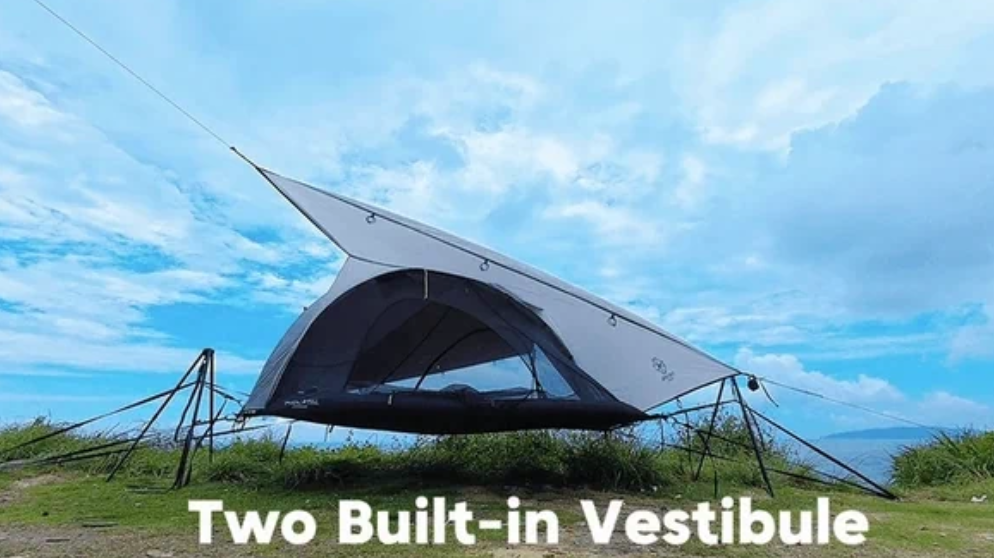
THECATAL’s floaty hammock tent can be set up on the ground or hung above it, which helps when a campsite does not offer two well-spaced anchors. On a site without suitable trees, the ground setup removes the need to tune suspension spacing for the location. The tent is waterproof and goes up in about 5 minutes with no complicated poles.
For campers moving through varied terrain, having both modes makes it easier to keep a consistent sleeping arrangement from one site to the next.
Ground Contact, Moisture, and Airflow
Comfort also depends on what a sleeper is not lying on. THECATAL says the Floaty’s elevated sleeping design helps users avoid uneven ground, rocks, and damp surfaces. The company also says its waterproof structure and suspended sleeping reduce exposure to ground moisture while improving airflow, compared with a conventional ground tent. For a camper on sloped or rocky terrain, that is a practical comfort gain that has nothing to do with sag.
Airflow cuts both ways, though. Ventilation that helps on a warm night can feel cool in cold weather, so campers expecting low temperatures should ask the manufacturer what it recommends for insulation beneath the sleeper.
Comfort for Two: Avoiding the Shared-Hammock Squeeze
Sharing a single traditional hammock compounds the sag problem. Two bodies pull toward the same low point in the fabric, which pushes both sleepers into close, awkward contact however carefully each tries to lie diagonally.
As a hammock tent for 2, the Floaty approaches this with an adjustable interior that divides the space into zones, so each person has some personal space inside the same shelter. A simple wider hammock still pulls both occupants toward one central low point, so a zoned interior is a different approach to shared comfort than adding width.
Setup Time and Gear Space as Comfort Factors
Comfort is not only about the lay. Arriving tired and spending a long time on setup affects the night, and so does a sleeping area crowded with packs and boots. The Floaty goes from backpack to bed in minutes, and its two built-in vestibules give gear a place beside the sleeping area, which keeps the interior less cluttered.
The design suits deep woods and a backyard retreat alike, which makes it a flexible choice for people whose trips vary from one weekend to the next. THECATAL covers the Floaty with a two-year warranty, worth factoring in for a shelter meant for repeated use.
Testing Comfort Over a Longer Session
A few minutes in a hammock says little about a full night. Lying in it for half an hour or more, in the position it will actually be used, brings out pressure points at the shoulders and hips that a quick sit-down hides. Using the sleeping pad and bag that will go on the trip lets the diagonal lay be refined through small changes to anchor height and slack.
Partners sharing a shelter can run the same test, each adjusting their own zone and noting whether they still drift toward the middle after a while. Small adjustments made at home are easier than discovering a problem at 2 a.m. on a trail.
What to Weigh Before Choosing
Hammock comfort is personal, so a few details deserve attention before buying: interior dimensions, how the suspension is set up, and how the lay feels on a first night. Practicing the setup at home or in a backyard shows how hang angle changes the lay before a trip.
The Floaty takes two routes to comfort: a structured, waterproof shelter, and the option to sleep on the ground or hung between trees. Which route suits a camper depends on the terrain and on how they sleep.
