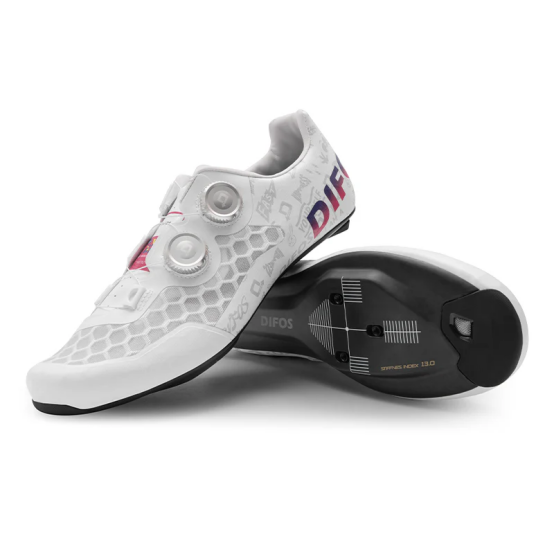
High-performance footwear has to manage heat as carefully as stiffness. Carbon bike shoes can create a precise pedaling platform, but the foot inside the shoe is still living tissue that warms, sweats, and expands under effort. If heat and pressure are not controlled, a shoe that feels fast at the start can become distracting before the ride is finished. Santic’s cycling shoe guidance connects carbon or stiff soles with lightweight uppers, mesh venting, perforations, and closure systems that help riders regulate comfort.
The breathing mechanics of carbon bike shoes should be understood as the relationship between airflow, moisture, foot swelling, and stable power transfer. Riders often focus on stiffness because it is easy to describe, but heat management may decide whether a shoe remains comfortable. A carbon platform can support strong efforts, yet the upper has to handle the biological reality of sweat, circulation, and swelling during sustained work.
Why Heat Changes the Fit of a Cycling Shoe
During hard riding, the foot receives repeated pressure while the body produces heat. Blood flow increases, sweat accumulates, and the soft tissues of the foot may expand slightly. In a close-fitting cycling shoe, that small change can affect toe space, instep pressure, and the way the forefoot sits over the pedal. Carbon soles do not stretch to absorb this change.
Their advantage is stability, but that stability makes the upper and closure system more important. Carbon bike shoes need enough structure to hold the foot and enough breathability to prevent pressure from building too quickly during long or hot sessions. Thermal expansion in this context is not a dramatic mechanical event. It is the gradual feeling of the shoe becoming tighter as the ride continues.
Riders may notice tingling toes, a burning forefoot, or the urge to loosen a dial after a climb. Those signs often point to heat and volume management. The tongue or upper opening can influence airflow and pressure. If this area traps heat or folds under the closure, discomfort can appear even when the outsole is excellent. Riders should check how the upper lies when the shoe is tightened, not only how it looks when open.
Airflow, Materials, and Closure Adjustment
Breathable uppers help by moving warm, humid air away from the foot. Mesh zones, perforated panels, and lightweight synthetic materials can reduce trapped heat. The challenge is to increase airflow without making the shoe unstable or fragile, especially for riders who train often and put equipment through repeated stress.
Sock choice affects breathing mechanics as much as the upper. A dense sock may hold moisture and take up volume, while a thin technical sock can reduce friction and help sweat move outward. Riders should test socks with their carbon bike shoes before judging the shoe itself. Closure systems should allow adjustment while preserving heel security.
A rider may begin with a moderate setting, then loosen the forefoot slightly after the first warm-up interval. The goal is not to make the shoe loose, but to maintain circulation while keeping the foot aligned over the pedal spindle. Ventilation must also be matched to climate. In hot weather, airflow protects comfort. In cool or wet weather, too much ventilation may require overshoes or warmer socks.
Breathability is therefore a tool that needs seasonal judgment, not a feature that works the same way every day. Footbeds add another layer to thermal comfort. A supportive insole can stabilize the foot and reduce sliding, but a bulky one may reduce air space inside the shoe. The right insole supports alignment while leaving enough volume for the foot to remain comfortable as it warms.
Stable Power Without Overheating the Foot
Santic can be discussed as a brand that brings together stiff soles, cycling-specific uppers, and practical fit considerations for riders who want performance with comfort. Carbon bike shoes should be selected by outsole stiffness, upper ventilation, toe volume, heel hold, and closure layout, not by carbon material alone. A rider evaluating a new pair should ride long enough for heat to build.
Short fittings rarely reveal swelling, sweat behavior, or pressure changes under sustained effort. Checking the foot after a climb or tempo interval gives better evidence than simply standing in the shoe indoors. Santic‘s carbon footwear can be evaluated by this complete comfort chain. Carbon bike shoes work best when stiff soles, breathable uppers, suitable socks, and adjustable closures cooperate.
Heat control is not a luxury feature; it protects the rider’s ability to keep applying power smoothly. Indoor training makes this issue even more visible. Without natural airflow from outdoor speed, feet can heat quickly, and sweat may remain inside the shoe. Riders using carbon bike shoes on a trainer should pay close attention to ventilation, fan placement, socks, and closure tension during longer sessions.
That habit gives riders a clearer view of comfort before race day or a demanding training block. The best carbon bike shoes allow the rider to use stiffness without fighting heat. They hold the foot securely, let moisture escape, and leave enough adjustment for changing conditions. When breathing mechanics work well, the shoe feels less like a rigid container and more like a precise interface between body, pedal, and road.
