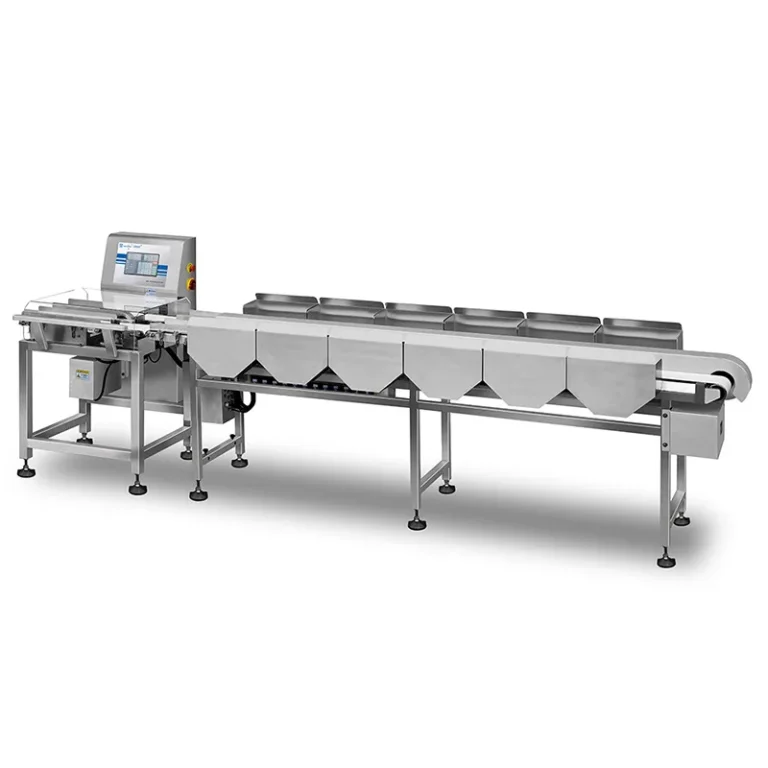
Fish processing speed is rarely limited by one operation. Delays can appear when workers weigh products individually, decide which grade each fish belongs to, or move products between sorting categories. These small interruptions become significant when thousands of fish pass through a production line.
A fish sorting machine changes this workflow by combining continuous weighing, automated classification, and controlled product movement. Easyweigh develops weight grading systems for fish such as salmon, tuna, cod, tilapia, and trout, with configurations designed for different processing requirements. The result is not simply faster weighing. It is a more continuous sorting process.
Where Fish Processing Loses Time Before Automation
Manual sorting creates several points where product flow can slow down. Fish must be picked up or inspected, weighed, classified, and placed into the correct group. Each action takes time, and the total delay increases with production volume.
Variation between products creates another problem. Fish rarely arrive at exactly the same weight, so operators must repeatedly make classification decisions. A high-volume line therefore depends heavily on worker speed and consistency.
Automation reduces these repeated decisions. Products can move through a defined weighing and grading sequence without requiring an operator to determine the category of every fish individually.
Continuous Weighing Removes the Stop-and-Check Cycle
A fish sorting machine measures products as they move through the processing line. High-precision sensors capture weight data and allow the control system to compare each measurement with preset grading parameters.
That changes the basic workflow. Instead of stopping production to determine the weight of individual fish, measurement becomes part of continuous material handling. The machine can then direct each product toward its assigned category.
Weight Sorting lists a Single Lane Weight Grader with a weighing range of up to 3,000g and stated accuracy of ±1g to ±5g, depending on configuration. Its fish solution also specifies operating speeds from 20 to 120 meters per minute. These are model-specific figures, not universal production rates.
Automatic Classification Keeps Fish Moving After Measurement
Weighing alone does not increase throughput if workers still need to interpret every result. Automated grading completes the next step by assigning fish to predefined weight categories.
The system can therefore combine measurement and classification within one workflow. Once a product’s weight is identified, the sorting mechanism directs it to the appropriate output position.
That consistency is particularly useful when a processor handles multiple weight grades. Operators can focus on overseeing the line rather than repeatedly making the same classification decision. Easyweigh’s fish systems are designed around adjustable sorting ranges, allowing different fish products and grading requirements to be accommodated.
Multiple Lanes Increase Throughput Without Simply Adding Labor
Increasing sorting speed does not always mean making one conveyor move faster. Product spacing, weighing stability, and discharge capacity can become limiting factors.
A dual-lane configuration addresses throughput from another direction. Two product streams can be handled simultaneously, increasing the amount of product entering the sorting process without relying solely on additional operators.
Weight Sorting describes its Dual Lane Weight Grader as a system for simultaneous weight sorting on two lanes. The listed design includes high-precision sensors, real-time monitoring, and production-line integration.
For seafood‑oriented configurations, the nominal conveyor speed can reach up to 120 meters per minute, with a weighing range up to 5,000g and stated accuracy ranging from ±1g to ±5g.
Note: 120 m/min refers to conveyor belt linear speed, not product‑handling pieces per minute. Higher precision such as ±1 g applies to smaller weighing sub‑ranges; full‑range 5000 g operation typically delivers accuracy closer to ±3 g‑±5 g. All figures are nominal model‑specific specifications; real‑world performance depends on product characteristics and factory operating conditions.
Machine Configuration Matters More Than Speed on a Datasheet
A higher stated speed does not automatically mean a faster fish-processing line. The machine must match the product and the way fish arrive at the sorting point.
Whole fish, fillets, and portions can differ in size, shape, handling sensitivity, and weight range. A configuration that works well for one product may not produce the same throughput with another.
Rotary-tray equipment provides another example. The fish solution lists a Rotary Trays Weight Grader with capacity of up to 300 pieces per minute and maximum nominal weighing accuracy of ±0.5g. The same source identifies applications including mackerel, tuna, and tilapia.
Note: ±0.5g represents maximum nominal accuracy achievable under ideal small‑range test conditions. Real‑world accuracy will degrade under factory‑floor conditions such as moisture, vibration and heavier‑weight seafood products. 300 pieces per minute is peak theoretical capacity; sustained throughput depends on product size and feeding consistency.
Real-Time Control Helps Prevent Small Delays From Becoming Bottlenecks
Speed must remain stable throughout production rather than appearing only during short periods of peak operation. Monitoring therefore becomes part of throughput management.
Modern weight grading systems can provide real-time production information while allowing operators to adjust sorting parameters. Weight Sorting specifically describes real-time monitoring and data analytics for its fish processing solution. This gives production teams greater visibility into line performance and sorting activity.
The value is operational rather than merely informational. If a sorting line begins to experience inconsistent flow, operators have more information available for identifying and correcting the issue before it develops into a larger production interruption.
Turning Faster Sorting Into a Faster Processing Line
A fish sorting machine improves processing speed by removing repeated manual actions from the critical path. Continuous weighing eliminates individual measurement steps, automated classification reduces decision time, and multi-lane or rotary configurations can increase product-handling capacity.
The greatest gain comes when the sorting system is matched to the fish, weight range, required grades, and upstream and downstream equipment. Easyweigh’s fish-oriented configurations show why machine selection should be based on the complete processing workflow rather than a single speed figure.
For processors seeking higher throughput, the relevant question is therefore not simply how fast a machine can sort. It is how effectively the equipment keeps fish moving from weighing to classification and onward to the next processing stage without creating a new bottleneck.
