In the rapidly expanding world of digital architecture, installing a building LED screen is a high-impact way to enhance a property’s value and visibility. However, these massive installations are more than just large televisions; they are complex engineering structures that must withstand the literal and metaphorical “heavy lifting” of the outdoor environment. For corporate buyers and project managers, understanding structural safety standards is not just a technical requirement—it is a critical risk management strategy.
When a digital display spans hundreds of square feet on the side of a skyscraper or at a busy intersection, the margin for error is zero. From wind load resistance to weight distribution, the safety of the public and the longevity of the investment depend on a rigorous adherence to international engineering codes.
The Physics of Load-Bearing: Static vs. Dynamic Forces
The primary safety consideration for any building LED screen is the dual challenge of static and dynamic loads.
- Static Load: This refers to the “dead weight” of the screen itself. A traditional outdoor LED cabinet can weigh significantly, and when multiplied by the total surface area, it can add several tons of weight to a building’s facade. A structural engineer must verify that the mounting surface can support at least 150% of the display’s total weight to ensure a necessary safety buffer.
- Dynamic Load (Wind Load): This is often the most overlooked factor. An outdoor LED screen essentially acts as a giant sail. In high-wind scenarios or hurricanes, the horizontal pressure exerted on the screen can reach thousands of kilograms. Standards such as the GB 50009 (Load Code for the Design of Building Structures) or local IBC (International Building Code) mandates require that screens be rated for specific wind zones. If the screen’s frame is not engineered to channel this force through to the building’s primary structure, the risk of a catastrophic “peeling” failure increases.
Protecting the Interior: Ingress and Environmental Sealing
A “safe” screen is one that is protected against internal decay. In the popular science of electronics, moisture and dust are the two greatest enemies of structural integrity. Ingress Protection (IP) ratings are the industry’s way of quantifying this defense. For an LED screen for advertising outdoor, an IP65 rating is the professional baseline.
The first digit (6) denotes that the unit is entirely dust-tight, preventing the buildup of grit that can interfere with cooling fans or cause mechanical friction. The second digit (5 or higher) ensures protection against water jets from any direction. Proper sealing prevents the corrosion of internal steel supports and mounting bolts, which are the silent anchors holding the entire project in place. Without these protections, “unseen” rust can weaken the structure over several years, leading to a sudden failure that has nothing to do with the initial installation quality.
Electrical and Fire Safety Compliance
In a B2B environment, fire safety is a non-negotiable compliance pillar. High-quality LED wall solutions must utilize fire-retardant materials for their internal components and enclosures. Standardized certifications like UL (Underwriters Laboratories), ETL, or CE are vital markers for buyers. These stamps indicate that the product has undergone rigorous testing for thermal management and electrical surges.
An efficient electrical design also contributes to safety. By utilizing high-efficiency Power Supply Units (PSUs) and optimized “Common Cathode” technology, the screen generates less heat. Excessive heat not only damages the LEDs but can also lead to the expansion and contraction of the metal frame, which, over time, can loosen bolts and compromise the mechanical stability of the entire installation.
Engineering Reliability: The QSTECH Y53 Series
When selecting LED wall solutions that meet and exceed these rigorous safety standards, their Y53 series serves as a benchmark for the industry. They have designed the Y53 with a “structural-first” mentality, ensuring that the engineering of the cabinet supports the safety requirements of modern high-rise and large-scale advertising projects.
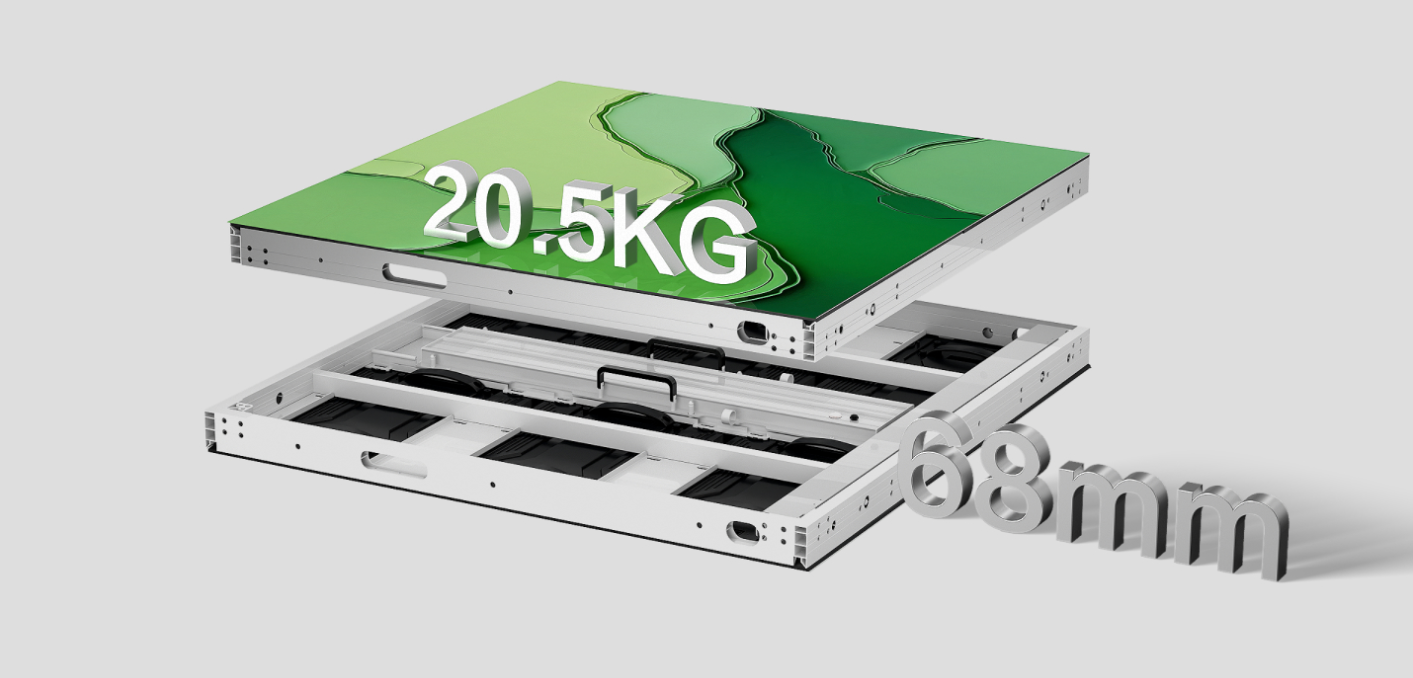
Technically, the Y53 series is engineered to reduce the structural burden on a building. While generic outdoor cabinets can be heavy and cumbersome, they have refined the Y53 cabinet to a weight of only 20.5kg per 960x960mm unit. This lightweight, slim-profile design (only 68mm thick) significantly lowers the “dead load” on the building facade, often eliminating the need for expensive structural reinforcements.
Beyond weight, their commitment to safety is evident in the Y53’s robust construction. The cabinets are made of a high-strength aluminum profile, providing a stable foundation that resists warping under extreme temperature fluctuations. The Y53 series also boasts full front and rear IP65/IP66 protection levels, ensuring the internal electronics remain hermetically sealed against the elements.
They have also integrated an intelligent “self-developed” monitoring system that allows operators to track the real-time status of the hardware remotely. This proactive approach to maintenance ensures that any potential fault or thermal anomaly is flagged before it can escalate into a safety risk, providing true “hassle-free” operation for the life of the screen.
Stability Through Precision
Their engineering doesn’t stop at the cabinet; it extends to the installation process. The Y53 supports various creative configurations, including 90° corner splicing and 3D naked-eye arc designs, all while maintaining the rigid structural integrity required for high-traffic public spaces. By choosing their hardware, buyers are investing in a product that has been “tested and proven” through rigorous aging, vibration, and thermal shock tests before leaving the factory.
About QSTECH
With more than three decades of experience and a reputation for excellence in the global display market, they are a leader in providing high-performance, integrated LED solutions. As a key subsidiary of the technology group CVTE, QSTECH benefits from world-class R&D resources and a patent portfolio of over 9,000 authorizations. Their unique advantage lies in their “All-in-One” philosophy—combining ultra-efficient hardware with intuitive smart control systems to simplify the complexity of digital signage for the professional B2B sector.
Ready to secure your next landmark project with industry-leading safety standards? Explore the Y53 series and discover how their engineering can provide a stable, high-impact platform for your brand.
