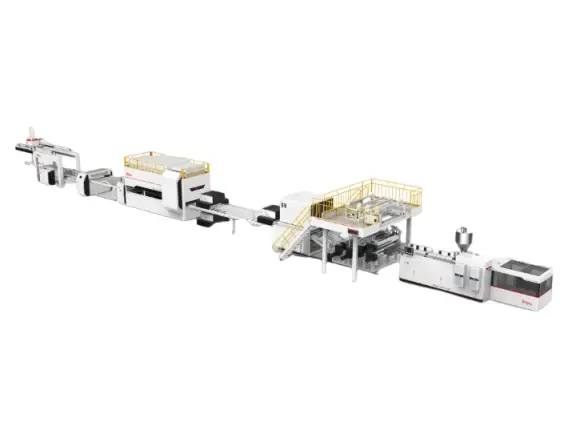
In the high-output world of industrial manufacturing, the cost of a single hour of downtime can be staggering. For Stone Plastic Composite (SPC) flooring manufacturers, maintaining a consistent flow is not just about speed—it is about the prevention of subtle mechanical shifts that compromise product density and click-lock integrity. The integration of smart alarms and real-time error detection within an SPC flooring production line has become the standard for B2B enterprises aiming for zero-defect manufacturing and long-term operational stability.
Enhancing Stability in the SPC Flooring Extrusion Line
The most critical errors often begin within the thermal zones of the extruder. A modern SPC flooring extrusion line utilizes a network of sensors to monitor torque, melt pressure, and temperature gradients across the barrel. Smart alarm systems are programmed to detect “drift”—minor deviations that might not stop the machine but could result in a brittle core. For instance, if the calcium carbonate ratio causes excessive friction, the system triggers an immediate alert to adjust the screw speed or cooling intensity, preventing a batch of unsellable material.
Beyond the extruder, error detection extends to the calendering and lamination stages. Sensors monitor the tension and alignment of the decorative film and wear layer. If the multi-roll calender detects a deviation in sheet thickness of even a fraction of a millimeter, the integrated software provides a visual alarm on the centralized control panel. This allows operators to make micro-adjustments to the roll gap before the error propagates through the entire cooling and cutting phase.
Technical Precision in the Boyu SPC Flooring Production Line
As a leading innovator in plastic extrusion technology, Boyu has integrated advanced diagnostic capabilities into their heavy-duty machinery. Their SPC flooring production line is designed with a centralized PLC system that acts as the “brain” of the operation, providing comprehensive data logging and fault diagnostics. This technology allows their partners to identify the root cause of an issue—whether it be a motor overload or a heating element failure—minimizing the time spent on troubleshooting.
The equipment provided by Boyu is engineered to support the rigorous demands of 2B industrial environments. Their systems feature remote monitoring capabilities, enabling technical teams to analyze performance data from off-site locations. By prioritizing the synergy between robust hardware and intelligent software, they ensure that their production lines maintain high uptime and material efficiency. For manufacturers focused on scaling production, their solutions offer the reliability needed to meet strict commercial delivery schedules without the risk of unexpected mechanical failure.
